


By Wolfgang Philipp
Published in July 2024
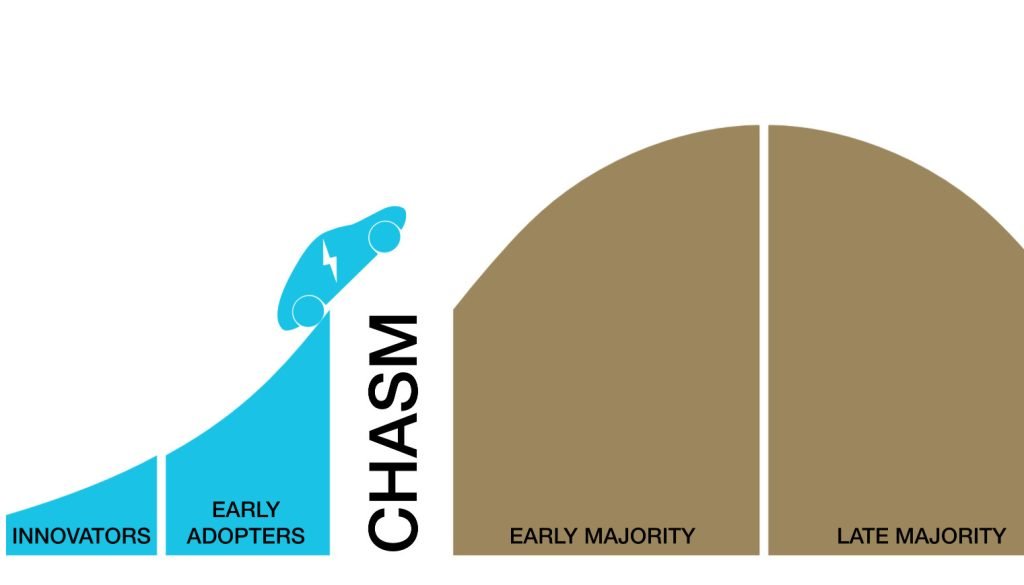
The BEV is at a pivotal point in the Technology Adoption Life Cycle, a framework that describes the absorption of new technology in society. The innovators start the cycle with their sheer enthusiasm for technology. The early adopters follow if they see potential in this technology to realize a greater vision.
This is exactly where the BEV is now. The innovators jumped right at it from the get-go for the sake of the technology itself: wow, electric cars. The early adopters were won over by the promise of zero-emission mobility.
Up next is the early majority – the first segment of the mainstream market – if it wasn’t for the chasm, “symbolizing the difficulty [the early majority] will have in accepting a new product if it is presented in the same way as it was to [the early adopters]”1.
Comprising roughly one-third of society, the early majority are the key to scaling up production and increasing profitability. But the early majority is fundamentally different from the enthusiastic innovators and the visionary early adopters. They are pragmatists who want to improve their mobility, not replace it. They don’t want to change to make electric mobility work in their lives. Price reductions cannot overcome their doubts.
Electric mobility has hit the chasm in the Technology Adoption Life Cycle — the pivotal transition from being a vision of the future to becoming the new standard. This article addresses the critical challenges of electric mobility going mainstream and provides three practical ideas for OEMs to solve them.
Today, OEMs sell their BEVs just like petrol cars. How to charge them is entirely up to the customer. This is a problem for the early majority because they are not willing to figure out the legal requirements, obtain authorization, study which wall box is compatible with their home grid, and find a provider to install it when they can simply buy another conventional car.
For them to make electric mobility work, OEMs have to sell the complete product—the car with a properly installed home charging station ready to use. This is a great chance for their dealers to demonstrate their local expertise. It’s easier and way more cost-efficient for a dealer to install hundreds of chargers a month than for each customer to individually find out about regulations and suppliers.
It’s also a great opportunity for the OEMs to strengthen their relationship with their dealers and promote them from being mere sellers to an integral part of the brand experience. The increase in pricing power by selling a complete product will outweigh today’s hefty price cuts, barely working to convince uncertain prospects to go electric.

One of electric mobility’s most persistent problems remains range anxiety. But more range is not the solution to the current BEV crisis. Larger batteries come at a price the early majority is not willing to pay.
As long as they have a charging station at home, the range of today’s BEV generation covers their everyday lives easily. Electric mobility would work for them just fine—if it wasn’t for the annual road trip to foreign countries during the holidays.
Even 1,000 kilometers of range cannot make up for the still patchy and probably incompatible charging infrastructure in foreign countries.
OEMs can solve that by simply providing a conventional car from the same brand for 14 days a year for free without mileage restrictions—until the charging infrastructure catches up internationally.
This way, OEMs can solve range anxiety for good without larger batteries. They can even upgrade their customers to a category for the holidays, such as a convertible or a larger van, which makes the trip even more fun than their compact BEV could provide. In the meantime, their BEV even gets maintenance.
The OEMs boost their brand experience and showcase their newest products. Also, the OEMs keep in touch with their customers beyond necessary service appointments, increasing brand loyalty.
Similar to the first idea, this one presents an excellent opportunity for the dealers to demonstrate their local expertise and customer proximity.
The early majority will own their car much longer than the innovators and the early adopters.
While the lifespan, resale value, and maintenance costs of combustion cars are highly predictable, the BEV is a complete black box from a long-term owner’s perspective. Will the battery still work properly in 10 years, and how much will a battery replacement cost if necessary? At the same time, battery technology progresses at lightning speed. Why not wait for the next generation?
In order to increase the resale value of BEVs, OEMs need to dramatically lower the cost of battery replacements. The only way to achieve this is by standardizing their batteries and agreeing on one common standard—an AA battery for BEVs.
A standard battery that can be installed in the car’s standardized crash-resistant and fireproof battery housing in any quantity, from single packs in compact cars to multi-packs in long-range SUVs. A common battery standard would increase production scales, improve recycleability, and decrease costs.
The option to choose from different battery suppliers would drive innovation and ensure that the latest battery technology is available for every used BEV, even decades later for cars gone long out of production. Every battery swap would be an upgrade with more range and less weight. This would boost the resale value of BEVs, giving OEMs more pricing power.
The early majority is the gatekeeper for electric mobility to become the new standard. These three ideas address their general concerns about going electric.
Get in touch to resolve the specific concerns for your brand’s target group.
1/ Moore, Geoffrey. (2014). Crossing the Chasm, 3rd Edition: Marketing and Selling Disruptive Products to Mainstream Customers, 22.

Darwin would be impressed: Within one model generation, the automotive industry has started a transformation unprecedented in the more than 100-year evolution of the automobile.
In this article, we take a look at the automotive revolution from a holistic marketing perspective and assess why, up until now, OEM brands seem to be missing their greatest opportunity in this new era.

Harley-Davidson’s latest model divides the fans: Is the Pan America the most exciting off-road motorcycle of 2021 or is it simply off-brand?
In this article, we are going to look at the DNA of Harley-Davidson, its off-road potential, and the Pan America’s brand compatibility: Are there winning ways ahead or merely bumpy roads?

Lancia is the sleeping beauty in Stellantis’ extensive brand portfolio. A brand that shaped the automobile – with inventions like the self-supporting body and design icons such as the Aurelia B20 GT, the Aurelia B24 Spider, and the Stratos – is being awakened by a kiss in a new era of mobility.
In this article, we take a closer look at the fame and glory of Lancia and why its best days are possibly yet to come.
You are currently viewing a placeholder content from Accessibility Widget. To access the actual content, click the button below. Please note that doing so will share data with third-party providers.
More InformationYou need to load content from reCAPTCHA to submit the form. Please note that doing so will share data with third-party providers.
More InformationYou need to load content from Turnstile to submit the form. Please note that doing so will share data with third-party providers.
More InformationYou are currently viewing a placeholder content from Vimeo. To access the actual content, click the button below. Please note that doing so will share data with third-party providers.
More InformationYou are currently viewing a placeholder content from YouTube. To access the actual content, click the button below. Please note that doing so will share data with third-party providers.
More InformationYou need to load content from reCAPTCHA to submit the form. Please note that doing so will share data with third-party providers.
More Information